What This Is
This is a working reference document. I tune cars in Forza Horizon, and I’ve gotten tired of running into the same “wait, is this number even meaningful?” question over and over. This is my attempt to write down, in one place, where Forza’s tuning system maps onto real-world physics, where it doesn’t, and how to work around the gaps to get a car set up faster.
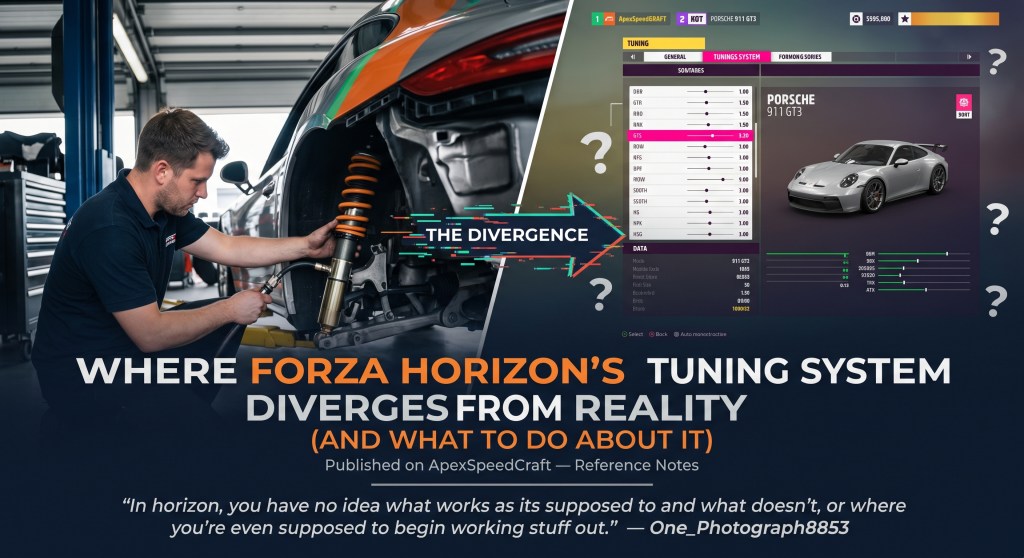
It was prompted by a Reddit thread from user One_Photograph8853, who laid out several observations about FH5’s tuning that I’ve independently bumped into and that are worth taking seriously. One short excerpt that captures the core frustration:
“In horizon, you have no idea what works as its supposed to and what doesn’t, or where you’re even supposed to begin working stuff out.”
That’s the problem this document exists to solve, or at least reduce.
The Core Problem: Simcade Opacity
Forza Horizon is a simcade, which everyone acknowledges. What’s less acknowledged is which specific parts of the simulation are real, which are tuned for accessibility, and which are presented in units that don’t map to anything in the physical world. Without that map, you’re flying blind. You can’t use real-world tuning knowledge because you don’t know where it applies. You can’t develop intuition from pure in-game trial and error because some sliders behave weirdly compared to what physics would predict.
The result: hundreds of hours in, you still don’t really know what you’re doing, you just know what works by pattern-matching.
This document is an attempt to separate the three categories:
- Real — behaves like physics predicts. Trust your real-world knowledge.
- Compromised — physics exists but is softened, exaggerated, or bounded for accessibility. Real-world logic partially applies.
- Opaque — unitless numbers or behaviors that don’t clearly map to anything. You have to learn by feel.
Springs: Bounded Compromised
Real-world spring rates for a road car sit in a surprisingly narrow band. For reference:
- Stock family sedan: 20-30 lb/in (roughly 3.5-5 kgf/mm)
- Performance street car: 150-300 lb/in (27-54 kgf/mm)
- Aftermarket “stiff sporty” coilovers on a ~1.7-ton R35 GT-R: around 20 kgf/mm front, 22 kgf/mm rear
- Track-focused street build: 400-600 lb/in (70-107 kgf/mm)
- Dedicated track/race car: 600-1200+ lb/in (107-214 kgf/mm)
- Formula 1 (the stiffest commonly-cited reference): 1500-4000+ lb/in (268-714 kgf/mm)
Forza’s minimum spring rates, particularly with rally suspension installed, often sit well above what any real car would run. On a 1.4-1.5 ton Mercedes 300SL with rally suspension, the minimum rear spring rate is reportedly 46.7 kgf/mm — stiffer than anything you’d ever put on a road-going version of that car, approaching dedicated track-car territory as a minimum. The maximum on the same car reaches 136.9 kgf/mm, which is genuinely in race-car territory.
FH4 apparently allowed softer minimums — one example cited is 16.9 kgf/mm minimum on a VW Beetle (still stiff for an 800kg car, but closer to reasonable). Something in the FH5 tuning system pushed these floors up.
My best guess at why: the physics engine probably needs minimum spring rates to keep the simulation stable. Very soft springs in a simulated environment can cause weird behavior — suspension travel clipping, numerical instability at high loads, bottom-out events that produce unrealistic responses. Rather than engineer around this, the simplest solution is to set floors that prevent the problem.
What this means for tuning: real-world spring rate math will point you at values Forza won’t let you reach. Don’t try to hit real numbers. Tune springs relative to each other — front-to-rear balance matched to weight distribution — and use the in-game telemetry (watch suspension travel) to confirm you’re not bottoming out and not running frozen. Absolute values are mostly meaningless; ratios and behavior are what matter.
If the minimum on rally suspension feels too stiff for off-road, try race suspension instead. Counterintuitively, race suspension often allows lower spring rates than rally suspension in FH5 for some cars, despite the naming. Check both before committing.
Tire Pressure: Likely Compromised, Possibly Bugged
Real-world physics: tire pressure and tire temperature are tightly linked. Lower pressure means more sidewall flex, more heat buildup, faster temperature rise. A tire set to 1.0 bar (about 14.5 PSI) on a hard-driven car will heat rapidly and potentially fail. A tire at 3.8 bar (about 55 PSI) stays rigid, stays cooler, and has a smaller contact patch but also much less grip because the tire deforms less over uneven surfaces and can’t conform to the road.
In Forza Horizon 5, setting tire pressure from 1.0 bar to 3.8 bar on the same car driven the same way produces nearly identical tire temperatures. This is not how real tires work. Either the game is using pressure primarily as a grip-curve modifier rather than a thermodynamic input, or the thermal model is so simplified that pressure barely influences it.
Note: FH5 is set in Mexico, which is hot, and Playground has openly discussed that tire temperatures run warmer than FH4 — community guides like ForzaTune recommend running 3 PSI higher than FH4 tunes as a result. That’s a deliberate design choice in the thermal model. But it doesn’t explain why pressure differences within a single tune don’t produce the expected temperature differences.
What this means for tuning: don’t expect lowering tire pressure to generate heat the way it would in real life. Use pressure in Forza as a responsiveness and grip setting, not a thermal one. Higher pressure = more responsive, less grip, stiffer feel. Lower pressure = more grip, softer feel, slightly more forgiving. Aim for 30-34 PSI hot on road tires regardless of what real-world logic suggests, and accept that the game’s “optimal” isn’t necessarily the physically-correct optimal.
Damping: Opaque
Real-world damping is measured in N·s/m (Newton-seconds per meter), which represents force divided by velocity — essentially, how hard the shock resists movement at a given speed. Typical numbers are huge: a street shock might be 1000-3000 N·s/m in compression, a race shock 3000-8000+. They’re never exposed to users as raw numbers; they’re exposed as position numbers on an adjustable knob (“click 5 of 10,” “click 12 of 24” on high-end dampers like Öhlins or KW). Those click numbers are specific to that damper and don’t translate between brands, let alone to a video game.
Forza presents damping as a 1-20 scale, with separate bump and rebound values for front and rear. There’s no documentation of what these numbers map to. My guess is they’re a normalized internal unit — where 1 is “nearly no damping” and 20 is “maximum the physics engine will accept before producing weird behavior” — scaled per-car based on mass and suspension geometry. But that’s guesswork.
The real-world tuning rules mostly still apply in spirit:
- Bump stiffness controls compression (hitting a bump)
- Rebound stiffness controls extension (after the bump)
- Rebound usually sits about 1.5x bump
- Stiffer dampers = more responsive, less forgiving; softer = more grip over bumps, slower response
- Too soft on bump = diving under braking, bouncy; too stiff = skipping
- Too soft on rebound = oversteer on turn-in; too stiff = understeer
What this means for tuning: the 1-20 scale is unitless and probably normalized, so numbers don’t transfer between cars and don’t map to real-world settings. Tune by feel and telemetry. The relative rules (rebound > bump, balance front-to-rear) still work. Don’t bother trying to translate a real-world damper setup into Forza numbers; it won’t.
Anti-Roll Bars: Opaque
Real-world ARB stiffness is usually expressed in lb/in of roll resistance, or as a diameter spec of the bar itself (e.g., “27mm front bar”). It translates loosely to roll stiffness contribution, which combines with spring rates and track width to determine how the car leans.
Forza presents ARBs as a 1-65 scale with separate front and rear values. Again, no units, no documentation. Probably normalized.
The tuning logic is the most robust part of Forza’s suspension modeling, in my experience:
- Stiffer front ARB → more understeer
- Stiffer rear ARB → more oversteer
- Stiffening one end without softening the other increases overall roll stiffness
- For a neutral car, match ARB balance to weight distribution
This is the one setting where I’ve found Forza’s behavior genuinely matches real-world expectations consistently. It’s probably also the most impactful single slider for changing a car’s cornering personality.
What this means for tuning: trust the ARB sliders. Use them as your primary oversteer/understeer balancing tool, and save the springs/dampers for dealing with bumps and weight transfer. ARBs are where Forza gets suspension tuning most right.
Alignment: Mostly Real
Camber, caster, and toe behave mostly like they should.
- Camber: more negative = more cornering grip, less straight-line grip. Real values. Trust your real-world knowledge. -1.5° to -2.5° is a reasonable range for most cars.
- Caster: more = more steering stability and self-centering. Works as expected.
- Toe: this one is the exception. Toe in Forza Horizon is known to behave unpredictably compared to Motorsport, and most community guides (including ForzaTune’s) recommend leaving it at 0.0 unless you have a very specific problem to fix. This is a simcade compromise.
Differential: Mostly Real, Good Tuning Tool
The differential acceleration and deceleration lock values (0-100%) map pretty cleanly to real-world LSD preload concepts:
- 0% = open diff
- 100% = fully locked / welded
- Values in between simulate LSD behavior with ramp angles
Real-world logic applies here. Higher accel lock = more power to the ground but more understeer in corners. Higher decel lock = more stability on engine braking but less turn-in. Drift setups using 100/100 “welded” behavior in-game actually behaves like a welded diff would in real life — the car refuses to turn tightly and wants to slide.
Center diff tuning on AWD cars also works as expected — shifting rearward produces more RWD-feel, shifting forward produces more understeer but better traction on loose surfaces.
Aero: Real, Mostly
Downforce sliders produce expected behavior: more downforce = more cornering grip at speed, more drag, lower top speed. The only quirk is that adjustable aero is only available on certain cars, and non-adjustable stock/street/sport aero kits still apply downforce values to the physics — you just can’t see or change them. This can produce surprising behavior on cars without tunable aero.
The Practical Takeaway
Given that springs are bounded, tire pressure doesn’t drive temperature the way it should, and dampers/ARBs use unitless internal scales, the most efficient way to tune in Forza Horizon is:
- Don’t translate real-world tuning values into Forza. You’ll either hit bounds or aim at numbers that don’t mean what you think they mean.
- Trust ratios and balance over absolute numbers. Front-to-rear spring balance matters; absolute spring rate mostly doesn’t. Damping balance matters; absolute damping value barely registers.
- Use ARBs as your primary cornering-balance tool. They behave most reliably.
- Use the differential as your primary power-delivery tool. It behaves reliably and has big effects.
- Use alignment like you would in real life, except leave toe at 0.0.
- Don’t expect tire pressure to affect temperature. Use pressure as a responsiveness dial.
- Use in-game telemetry for feedback, not target numbers. Watch suspension travel, watch tire temps, watch grip balance — but understand the numbers themselves are normalized.
The 350z-on-a-real-track observation from the Reddit thread — that the stock car is far grippier in reality than it feels in FH5 — is consistent with everything above. The game’s spring rate floors, softened tire thermal model, and generalized physics tuning are all pulling in the direction of “every car feels slightly floaty and understeer-prone compared to real life.” That’s the simcade compromise in its most visible form.
Open Questions (For Later Verification)
Things I want to verify when I have telemetry data pulled from the game directly:
- Spring rate floors: are the minimums actually physics-engine limits, or arbitrary design choices? Test by observing simulation behavior near the minimums — looking for bottom-out events, numerical instability, or clean simulation.
- Tire pressure and temperature correlation: quantify the actual relationship. Run tests at 1.0 bar, 2.2 bar, 3.8 bar on the same car/same lap/same conditions and measure peak and average tire temps with telemetry. If the delta is <5°C between extremes, the thermal model is definitively broken; if it’s >20°C, I’m wrong and the in-game indicators are just imprecise.
- Damping scale: does 1-20 scale linearly or exponentially? Does the scale change per-car? Test by holding all else constant and varying one damper value through its range, measuring suspension travel response to a standardized input.
- ARB scale: same question as damping. How does 1-65 map to actual roll stiffness contribution?
- The 350z gap: is the stock 350z actually less grippy in FH5 than in reality, or is it a perception issue from camera, FOV, or controller input damping? Test by running the stock car on a controlled section and comparing lateral g-loading against known real-world figures.
Once I have those answers, I’ll come back and correct whatever I got wrong here.
If you’ve done your own testing on any of this and have data, I’d love to see it. Drop a comment or reach out directly.


Leave a comment